Standard commercial garage door sizes range from 8 to 32 feet wide and 7 to 24 feet high. For most logistics and high-traffic applications, a 14x14 or 16x16 door provides enough clearance for large trucks and machinery. Choosing the correct size prevents equipment damage, improves safety, and avoids costly operational downtime.
Getting these measurements right ensures your daily operations run efficiently as you integrate the correct garage door components. Let us look at how to choose the exact dimensions for your building and avoid expensive installation mistakes.
- How to Choose the Right Commercial Garage Door Sizes
- Common Commercial Garage Door Dimensions by Type
- Calculating Required Structural Clearances
- Wind Load Requirements for Commercial Doors in Florida
- Maximizing ROI on Commercial Garage Door Upgrades
- Schedule Your Commercial Garage Door Installation in Tampa
- Frequently Asked Questions
- What are the standard commercial garage door sizes?
- Are wind load-rated commercial doors required in Tampa?
- How much clearance space is needed for a commercial garage door?
- Do insulated commercial garage doors reduce energy bills?
- What is the lifespan of a commercial rolling steel door?
How to Choose the Right Commercial Garage Door Sizes

You must match your garage door dimensions to your daily workflow. This strategy prevents equipment collisions and supply chain delays. Utilizing standardized dimensions also makes it easier to locate replacement parts quickly.
- Standard loading docks: The industry standard measures 8 feet wide by 10 feet tall. This size accommodates standard forklifts and cargo trailers.
- Small bays and vans: The standard opening is 12 feet wide by 12 feet high.
- Warehouses and repair shops: Standard access requires 14 feet wide by 14 feet high.
- Large machinery and logistics: Heavy-duty facilities require 16 feet wide by 16 feet high, or 18 feet wide by 16 feet high.
- Oversized industrial access: Massive facilities use doors up to 30 feet wide, or 20 feet by 18 feet. Custom sizes are available to reach 30 to 40 feet wide for specialized machinery.
- Service counters: Retail cafes and concession stands use counter shutters measuring 4 to 12 feet wide.
Common Commercial Garage Door Dimensions by Type
Different construction materials support different maximum dimensions. Understanding these limits helps you select the right style for your opening.
- Rolling and coiling doors: Standard dimensions are 12 to 20 feet wide and 14 to 18 feet high, though custom applications can exceed 30 feet.
- Sectional steel doors: These commonly range from 20 to 26 feet wide and 16 to 24 feet tall.
- Full-view aluminum doors: These typically measure 20 to 24 feet wide.
Calculating Required Structural Clearances
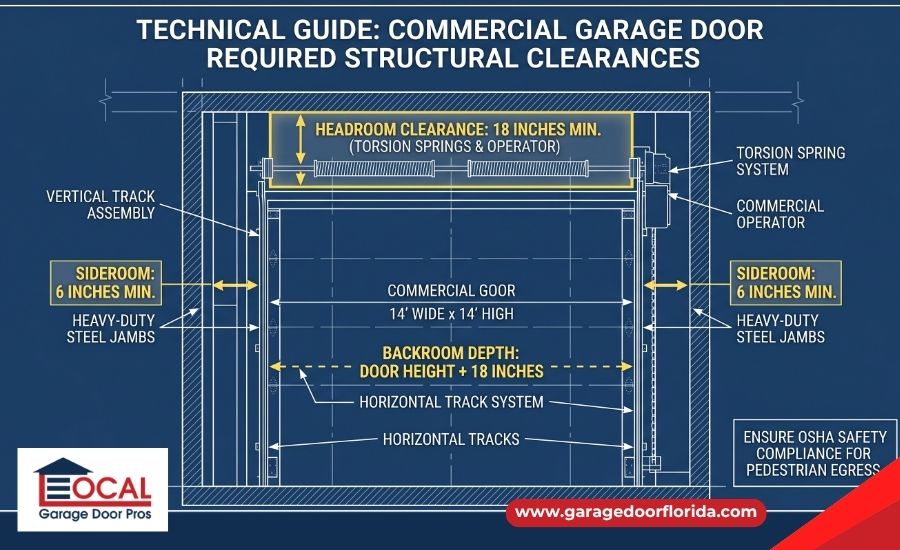
A common error is measuring only the rough opening. You must calculate the required empty space for the commercial track mechanism. Staying compliant with OSHA safety guidelines ensures your installation provides sufficient space for safe pedestrian egress.
- Headroom: Leave at least 18 inches of clearance above standard lift doors for the springs and operators.
- Sideroom: Leave a minimum of 6 inches on each side of the opening. This provides enough space to install heavy-duty steel jambs.
- Backroom: The depth running into the building equals the door height plus an additional 18 inches.
Wind Load Requirements for Commercial Doors in Florida
Coastal regions enforce strict building codes for industrial access points. These codes prevent weak doors from blowing inward during severe weather. A failed opening creates internal pressurization, which causes catastrophic roof failure.
Check your local regulations for specific Design Pressure ratings. These ratings measure the exact positive and negative wind forces a door withstands. Using heavy-duty steel and impact-resistant materials maintains legal compliance and protects your inventory from flying debris.
Maximizing ROI on Commercial Garage Door Upgrades
Upgrading your facility doors operates as a financial strategy. It lowers daily operating costs and prevents supply chain downtime. Smart material and component choices yield a steady return on investment.
- Energy efficiency: Polyurethane-insulated sectional doors regulate internal building temperatures. Following Department of Energy insulation recommendations helps you select the correct R-value for your specific climate.
- High-cycle springs: A standard commercial spring breaks after 10,000 cycles. Upgrading to high-cycle springs rated for 50,000 uses prevents sudden operational failures at busy distribution centers.
- Customization and security: Opting for insulated panels improves energy efficiency, while heavy-duty steel upgrades maximize your perimeter security.
Schedule Your Commercial Garage Door Installation in Tampa
Protect your commercial facility with appropriate industrial access solutions. Book your professional commercial garage door repair in Tampa to ensure your structural upgrades meet all local building codes.
Local Garage Door Pros is a full-service garage door company serving the Tampa, FL area, specializing in residential and commercial garage door repair, spring replacement, and emergency installation services for local property owners.
Frequently Asked Questions
What are the standard commercial garage door sizes?
For warehouse and industrial access, 12x12, 14x14, and 16x16 feet are the most common sizes. Most logistics applications utilize a 14x14 or 16x16 door to provide adequate clearance for large trucks and machinery.
Are wind load-rated commercial doors required in Tampa?
Yes. Florida building codes require wind-resistant commercial doors for all new installations and major renovations. Noncompliance leads to failed building inspections and municipal fines.
How much clearance space is needed for a commercial garage door?
Most standard track configurations require at least 18 inches of headroom above the opening. You must also leave a minimum of 6 inches on each side for heavy-duty steel jambs.
Do insulated commercial garage doors reduce energy bills?
Insulated doors trap cooled air inside your building and block the Florida heat. This temperature regulation reduces daily HVAC costs and extends the lifespan of your cooling equipment.
What is the lifespan of a commercial rolling steel door?
A properly maintained rolling steel door lasts 15 to 20 years. Schedule regular maintenance and lubricate the moving parts to ensure maximum longevity.
Recent Posts
-

Diagnosing a Garage Door That Jerks When Closing
Jul 26, 2026